Monday, March 30, 2009

Does technology reveal too much personal information?


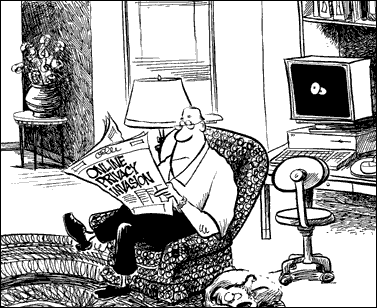
As technology advances continually, our privacy also diminishes. Everything we do using any technology can be viewed and used to see what our interests are, and even things we do every single day. Most companies have either already moved most of their info onto some sort of technological system or may soon make the move. With our personal information being available from many places like our own personal computer, businesses computers, and the online world; our personal lives can be accessed easily by anyone.

One of the easiest ways for personal information to be accessed by anyone is online. Sometimes we readily give away our personal information on sites like Facebook and Myspace, but other times we can often be tricked into giving our personal information away or not even know that we are giving the information away.

When using our email we often sign up for certain messages from certain businesses. However, these companies give away these email addresses to other similar companies which also send us emails in hopes that we are interested in products they have. This is one aspect in which we as consumers are targeted to buy certain things only because these companies might know what some of our interests are. Another technology that uses our information is I tunes. I Tunes has access to all of our music that we put into it. I Tunes now has a feature called Genius in which it predicts songs we might like based on what music we already have. This can be really nice to use when I am interested in listening to some new music, but they are targeting me to buy more music by recommending music they already know I am interested in. Should companies be allowed to use what they know interests us and have access to this information when trying to sell products? Some people like this feature and it could even make buying products easier, but does that mean it is ethical or morally right to do?

Using the internet also puts us at risk to viruses and online fraud in which many lives can be ruined. Viruses can be used to gather personal information and even access to bank accounts through information we put on the computer ourselves. It seems that going online can be very dangerous, and can affect our own personal safety. Sometimes we can easily forget this, and put some aspect of our lives at risk through using the internet. Over the summer I put myself at risk through using the internet and my bank account was hacked into by someone who put up misleading information on a website which tricked me into giving account numbers and what not. I eventually got all my money back, but it was a definite hassle that took extra time and effort out of my life to deal with. When I look back on that situation, I wonder sometimes is the internet worth as much as we think it is if it is putting our lives at risks whether it be something to do with finances or personal info?

One of the issues that I feel I debate about with myself constantly, is the issue of privacy and social networking sites. On these sites we readily give away our personal information and when we do this we rarely question what the consequences might be from doing this. In our reading on privacy Marx said that privacy is important because "Privacy is a resource in inter-personal relations, doled out and exchanged as relationships progress. Intimacy is based partly on the voluntary sharing of personal information with others. Individuals feel free to be “themselves” as they get to know others better, and reciprocal exchanges take place." Depending on which sites you use and what information people can see, other people are then allowed to make judgments and opinions about us by just visiting our profile pages. I personally do not like this because I think that we should give and be given a fair chance when first meeting someone so that we can make good impressions rather than bad ones. Online sites such as Facebook do not really allow for giving people fair chances especially if you do not know a person very well or at all. Our sites may reflect who we are, but people viewing the profiles might view you differently than you would expect them to. This changes the whole process of getting to know someone, and how relationships are traditionally formed. Rather then me being able to tell someone my interests they can look them up online and already know my favorite book or movie. This disintegrates the relationship drastically, and takes away from getting to know someone, moving on to trust them, and affects the intimacy level of that relationship. I do not have a problem with putting up information about myself, but in a world where people may use it against me it might be better to not post it, and avoid the detrimental affects in the long run.

In Europe, Meglena Kuneva, the European Union Commissioner in charge of consumer rights recently issued a warning on Internet User Rights. They want Internet site operators to work within regulators to better protect users. In Europe they also have realized that the internet has lured its users to give away too much personal data. They say that in Europe they have always favored self regulation by the industry, but if these abuses keep occurring they will make new rules to decrease the rate at which personal data is being gathered and given away.
http://www.msnbc.msn.com/id/29957812/

In the future I hope that there will be more privacy laws regarding the internet and other technologies. It is hard to say when and if it will actually happen, but the issue at hand cannot solely be blamed on the technologies that put our personal lives at stake. We as people also need to be careful about what we post and let the public view. We do not walk around the city with a list of our interests or phone numbers posted on our backs, however online it is as if that is what we are doing. Corporations and ourselves need to be more careful about what can be made available to the public. I think it will also be important to one day have boundaries as to what information companies can collect from us based on the technologies we are using. It is important to ask whether these technologies are actually helping us or are they ruining us? We might not be able to see all the things they are doing, but it doesn't mean it isn't happening.

Thursday, March 26, 2009

Chat Room Relationships

Chat rooms provide a way for people to communicate information to others via text, webcam, or in a graphical multi-user environment (like World of Warcraft.) Chat rooms can be very helpful to some in providing an easy way to communicate with a large or small amount of people in a real time situation.

After reading "A Rape in Cyberspace" and discussing the many controversial issues within the article in class, I felt very two sided and unsure on how I felt about what happens in some chat rooms.

There are many websites in which people can chat, and they have become far more advanced from what the chat room was like in the article. People can now pick a topic they want to talk about and easily go in and chat. Now people who want to engage in sexual conversation can easily access others who also want to engage in this type of conversation by simply going into the chat room that best describes what their looking for. Sometimes it is simply just a chat and two people go away with what they may or may have not wanted. They may or may not talk again, but it stayed within the virtual world and never entered the realms of something that would happen face to face, like what happened in "A Rape in Cyberspace." On the other hand, it may not always be just a chat and the person on the other end of the chat may want a real world engagement not just a virtual one. It is in these instances that a chat room can start to become unsafe, and the information you post or tell others willingly can sometimes end up putting yourself at risk.

A huge issue that has been growing since the Internets popularity has increased has to do with internet predators. Internet predators use an alias and often act as a young child in childrens or teens chat rooms and talk to them and lure them to "hang out" outside of the chat room. Usually the intent of the internet predator is not good and most sexually molest these children they have met online in the chat room. In Wisconsin, agents who work on catching these internet predators and putting them behind bars have seen an increase that has quadrupled in the past ten years. One of the agents even went on to say, ""I don't think we've made significant progress at all, our community leaders don't even know how bad the problem is. The general population has no idea."

This youTube clip shows how easy children can get lured by internet predators.


As the internet has advanced and become cheaper and faster, the internet predators have also become better at what they do and more cautious about being caught with the invent of tv shows like "Catch the Predator." Last year alone, there were 3000 arrests having to do with Internet crimes against children. However, that was not nearly the amount of people online performing these crimes. Agents have a hard time cracking down on these predators and say they need more people to help with the arrests and time to find these online predators. One agent even asked, "What's more important these 10 speeders getting tickets or this kid not getting sexually molested?"

http://www.msnbc.msn.com/id/29793814/

Should we continue to allow chat rooms for minors to exist? Or should the security measures to allow someone into a chat room be greater? Should chat rooms have such open topics where people can participate in cyber sex? Or would that violate our freedom of speech? How did chat rooms evolve from a safe place of communication online to a place where one could be singled out for an attack from a predator? How can we make the internet safer for the younger generation to browse safely? Is there another way to eliminate internet predators?

Monday, March 23, 2009

Technology and the Generational Gap


As technology becomes increasingly used by more people in their everyday lives, a generational gap is also dividing many relatives, acquaintances, and even co-workers. Jenkins said that as the rate of technological and cultural change accelerate young people will have different cultural values and styles than their parents. Along with that Jenkins also said that when we live in different media environments we use technologies differently and form contradictory interpretations of experiences.

Within my own family I can see a generation gap between the younger, middle, and older generations. Everyone grew up within different eras, and we all had different methods of watching tv, listening to the radio, using the phone, and being able to use a computer. Some people are able to stay up to date and learn with the new technologies like the younger and middle generation. However, the older generation has a harder time adapting to the newer technologies like a computer since they have lived most of their lives without it. An example of this within my own family is my grandma. My grandma does not use a computer at all. She has bad arthritis and uses a typewriter for things she needs to type, but for her that's normal and was more a part of her life than the computer is. She also has a phone which she barely knows how to work, but its an older model which she only brings out with her when she goes out, and always is off. Many of us have tried to show her how to use it more and get her a newer model, but she says she doesn't want to mess with the phones because they are too complicated. While I on the other hand use both a phone and computer daily with ease. This agrees with what Jenkin said about forming contradictory interpretations of experiences. Not being able to understand the way one another thinks we have differing opinions about technology, and value certain things more than different generations would. Sometimes this can harm relationships between people of different generations because of this difference of opinion.

In an article (http://www.nytimes.com/2008/03/09/business/09cell.html) from NY times it mentioned how "children increasingly are relying on technological devices to create social circles apart from their families that change the way they communicate with their parents." It also noted that there has always been a change within society as certain technologies become more ubiquitous. The author gives many examples of technologies that have widened the generation gap like the progression of the phone, the invention of the automobile, computer, and internet. And in using these technologies the younger generation is very connected, and far more independent than their parents were at that age. The cell phone is a technology that is causing a generation gap, and causing problems between some children and their parents. Parents are upset that a child could be doing anything right in front of them while they are on their cell phone, and they would never know. Parents have been confused as how to communicate with their children since it seems their world revolves around their phone. To solve this some have learned how to text and communicate via the phones making things not so tense, and filling in only a small part of the generational gap.

Will the generational gap be a continuing trend as we grow older? Will we, when older, be as open to technology as we are now? What new technologies will be invented that we would never imagine seeing that might cause tension between us and our future children or the future younger generation?

Sunday, March 8, 2009

Convergence of Cell Phones in our Lives


Cell phones have become increasingly used, and almost a daily norm. But have we taken cell phone use too far?

On my cell phone I can use the internet, take pictures, text or email someone, play games, find a location, play a game, schedule an event, or even talk on it. The original cell phone was only able to make calls and was huge and bulky. Now we can do almost anything on a cell phone at any moment in time as long as you are in an area that receives service. Along with the technological changes in the first cell phone and a present day cell phone, these changes in turn have impacted our relationships. We can now do things we would normally do on our computers at anytime and anywhere because of our cell phones. The technology has become so advanced that it can do almost anything it seems like.


One thing that I have noticed a cell phone can also do that is not listed on the features of the box is that it impacts my personal relations with others. It is beneficial that I can communicate with my friends easily, and I can access information quickly using the mobile web. However, it is harmful too. I can choose not to talk to someone easily by simply screening calls, or not responding to a text message. It also engages us in "continuous partial attention" almost always. I am guilty of the continuous partial attention and it is very hard to get away from. Recently I noticed how on edge I was from using my cell phone too much. I was texting almost always, even when I was spending quality time with others, like my boyfriend. Of course he did not like this. Why would you want to spend time with someone who is constantly on their phone? I must admit I hate spending time with someone who is continuously texting especially while they are talking to you. You wonder whose conversation they are more engaged in, and if they would rather be doing something else than being there with you. As I noticed this in myself, and how my cell phone was taking away from my daily interactions in the real world, I wanted to change how I use my cell phone.

McLuhan said that "The medium is the message." I think we all have forgotten what the cell phone was originally intended for and have been distracted by the content the cell phone has brought along with it recently. Because of this it has definitely shaped the way we think , act and perceive the world around us like McLuhan said.

After reading many articles that said turning of your cell phone and getting away from the internet can be beneficial for one, I decided to give it a try myself. I have noticed that when not always expecting a text or constantly checking my phone I have become less anxious, and more relaxed. I realized I was not missing out on much, and I didn't need to text as much as I really thought. I also have no problem now ignoring a text and not responding while in class, with friends, or even in a movie theater. The content in these text messages usually can wait and are not that important that they need to take up my time constantly. In the article "Being Always On," the author states that studies in other countries who have had cell phone use much longer than our nation, people have no problem turning off their phones during work, studying, and during other daily rituals.
http://www.sciencedaily.com/releases/2008/05/080520161340.htm

Do you think that all the hype with cell phones will decrease and our society will find a way to balance cell phone use more equally into our lives instead of letting it take over our lives? Will we realize that cell phones do not need to be a necessity in our lives, and become less hooked to them? Or will the trend of cell phone use, whether it be texting, surfing the web, or talking , continualy increase as the technology gets better and better?


New Media and Our Everyday Lives

New media technology has been created, adopted, and absorbed into the culture at increasingly dramatic rates. With the addition of all this new media many people throughout the world have been affected in both their cultures and society they associate with. With the many different technologies that exist and that are being invented it seems that technology is shaping our society. Jenkins explained characteristics in new media landscape that are almost controlling and dictating our relationships with others.

One of new media's characteristics that Jenkins lists is "everyday." New media technologies have become such a huge part of our lives that it has integrated into our everyday social interactions. Jenkins is definitely right. Every single day I use my laptop, my cell phone, my i pod, television, and many other technologies that it seems I can't live without. Technology has shaped my social interactions. I have to check my email daily or I could miss something important for deadlines in school. Most of my friends communicate to me via my cell phone or through Facebook. If my computer or cell phone were to stop working I think my life would be hectic. I would have no form of of communication with others except for personal contact. I do not think I would even be able to wake up on time since I use my cell phone as an alarm clock. Jenkins is right, new media does become dangerous as it becomes part of our daily lives. We do not realize that there is a layer of media surrounding us, and we become dependent upon it too much.

A recent news article stated that Utah residents are the biggest consumers of porn on the internet in our nation. For every 1000 broadband users, 5.47 people have subscriptions to porn sites in this state. For some people this news is very shocking, and the article also found that the most conservative and religious states have higher rates of porn site usage. This is interesting because for most of these people they are stepping out of what their culture and religions go against. Typically most people would think that the more conservative and religious states have the least amount of porn site usage. However, as the internet has become a daily part of most of our lives in this nation it is also easy for people to hide their identities and remain anonymous online. People we socialize with everyday do not know what we may be doing on the web, and people can house many secrets this way.

The use of these porn sites has become a daily routine for many, even within religious communities...

"Church-goers bought less online porn on Sundays – a 1% increase in a postal code's religious attendance was associated with a 0.1% drop in subscriptions that day. However, expenditures on other days of the week brought them in line with the rest of the country, Edelman finds."

http://abcnews.go.com/Technology/Business/Story?id=6977202&page=1

Did the internet turn these people away from their beliefs? Has daily interactions on the internet changed our values we might have had before we used this technology? Will these secrets that we keep online destroy our relationships with others in the real world? Does the daily use of media in our lives change only the way we live or does it also affect our personalities and habits?